

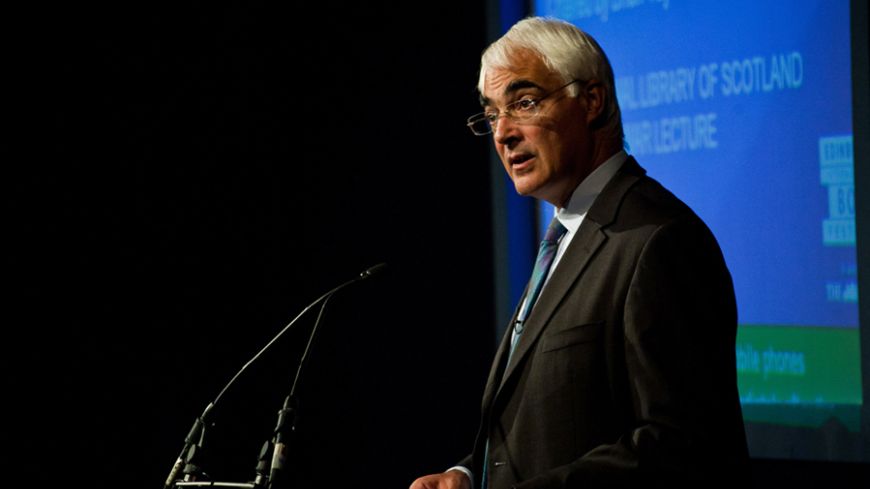
The present Shadow Chancellor had a suitably large audience in the Main Theatre of the Edinburgh International Book Festival for what promised to be one of its most interesting events.
Alastair Darling has always seemed his own person rather than a creature of party. His approach to the task of Donald Dewar Memorial Lecturer was going to be interesting, or so one hoped. Inevitably, perhaps, he chose to speak of what he knew best. After some warm tributes to Dewar, both from chair Brian Taylor and Darling himself, talk turned to politics and our present troubles.
Darling presented a careful, yet honest appraisal of the international financial crisis, its handling by the previous administration and his views on the measures of the coalition government.
At this point, it is only honest for this reviewer to relate something of his own experience; to experience unemployment in the 1980’s was to appreciate at first hand the lack of resources (and will of different governments to improve these) available to those seeking work, and thus to be fearful for those now facing up to how "austerity measures" may blight both their own lives and those of society’s most vulnerable; to witness twenty per cent of the value of two blue chip share portfolios disappear in as many days, to (interim) encounter a friend whose retirement funds, invested in a ‘safe’ high street bank, had disappeared in less time, is an education in the meaning of ‘banking and financial crisis’, while such two pairs of spectacles can induce double vision bordering on the schizophrenic.
Darling has always been ferociously candid in his assessments, as the reaction to his forecast of ‘the worst crisis for sixty years’ attests. That this now seems Panglossian in its optimism perhaps says more about the road we have since travelled than the man who showed us the way.
His candour certainly did not spare those who chose to ignore the warning signs, and his tale of the banker who assured him that ‘measures were now in place to avoid such mistakes’ is telling as an instance of the naïveté so frighteningly prevalent at the time.
Darling was less forthcoming on the actions of the present coalition but almost certainly right in ascribing the origin of our problems to the Thatcherite insistence on ‘freeing’ capital into world markets and the growth of the City of London as a hothouse of financial ‘products’, few of whose creators understood the potential effects of what they sold.
Equally, and despite the prophecies of the press, Darling was fulsome in his praise of Gordon Brown’s actions to minimise the effects of crisis. If the world was not quite saved, it has almost certainly been made safer by the actions Brown took and persuaded other countries to emulate.
Darling regrets the inability of the previous government to communicate this achievement to the electorate, but few administrations achieve four terms of office, and unavoidably appear tired and lacking ideas after three. Two years on, those portfolio have regained their value, but markets continue fretful and sluggish. Whatever the future holds, we are unlikely to see a ‘bright confident morning’ any time soon.